Sunday, June 23, 2013

Pictures upon pictures.

My mom used to tell me a watched pot never boils. I started to think that applies to plants growing this season. I want to wake up some morning and see the plants doubled in size. This may be a big request, but I know it actually is possible. However, this cold spring has truly been a challenge for most things we put into the ground. Somedays it feels like the plants are the same size as when they were planted over one month ago. But when I look at the last pictures I shared with you, I realize A LOT has changed and grown and greened up and only we have had the pleasure of seeing it. Despite the cold and rain and wind, this has been a most enjoyable growing season thus far. Let us share the last month with you and entertain your eyes with all we are blessed to be part of...


Staking the tomatoes in the tunnels.
Mulching in the tunnels.
Bringing row cover out to the field...yeah, its May 2nd and we are in heavy coats and layers and stocking caps.
Laying down row cover in preparation for the May 3rd frost.
"The G" loaded with plants.
"The 504" ready for for transplanting.
Changing the spacing on the transplanter.
Check out these green beans breaking through the ground!
The lettuce field.
A look at the farm with peppers in the foreground.
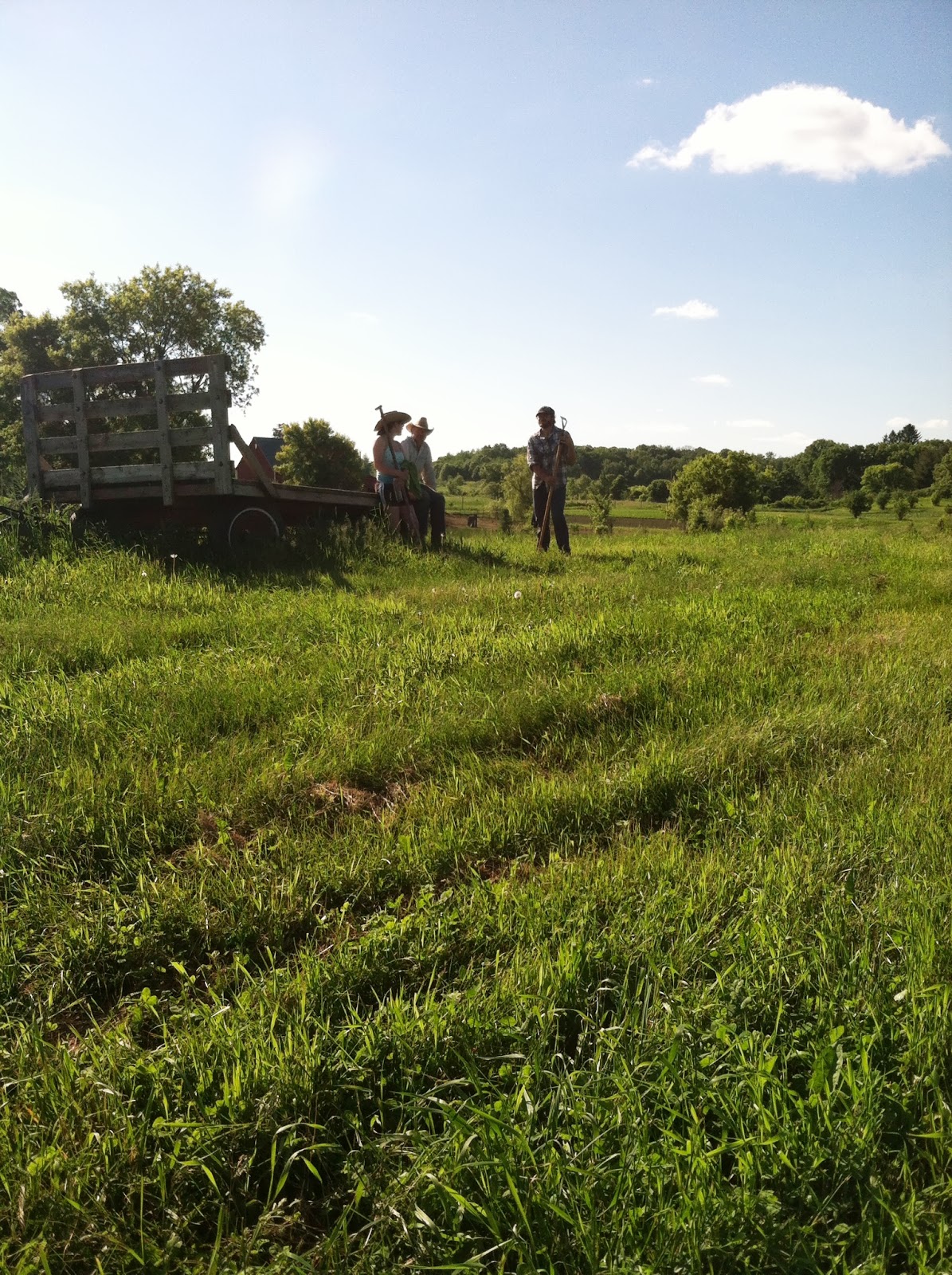
Molly and Jane out in the pasture.
Sunday morning chores: water the horses.
Its a double rainbow all the way...woah thats so intense.
Hoeing the Chinese Cabbage.
Bringing plants to the field to put in the ground.
Hand transplanting Zucchini
Recapping after a full week of work.
Ben and Dan cultivating with Molly (one of the draft horses).
Ben drove Molly and Dan cultivated.
The lettuce field right before harvest day.
The first harvest.
Harvesting
The harvest shed.
Washing the produce.
Hauling tomato stakes to the field. 
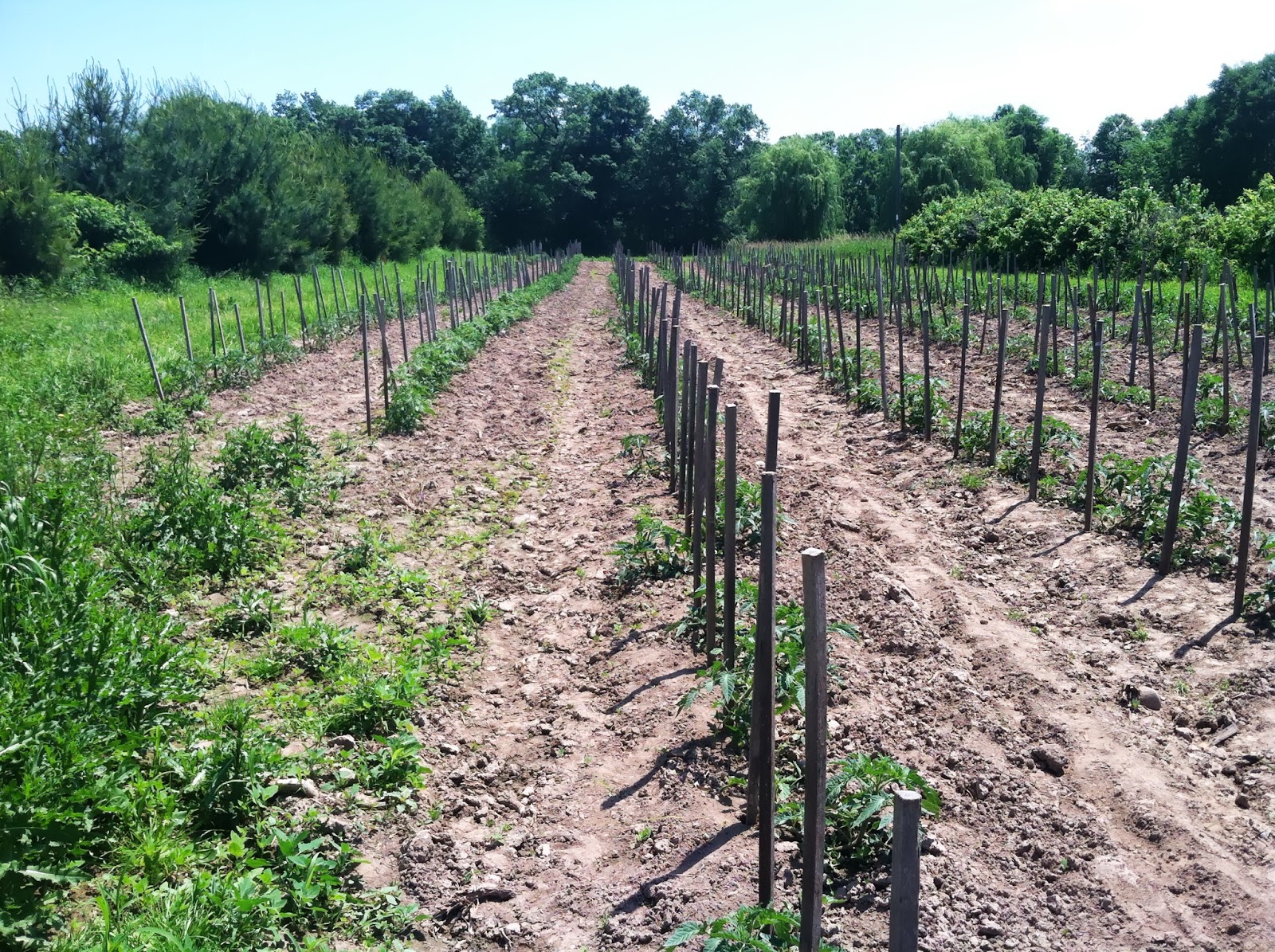
Laying out tomato stakes.
One field of tomatoes all staked. 
The first tie...we will tie tomatoes three times.
Kale field mulched.
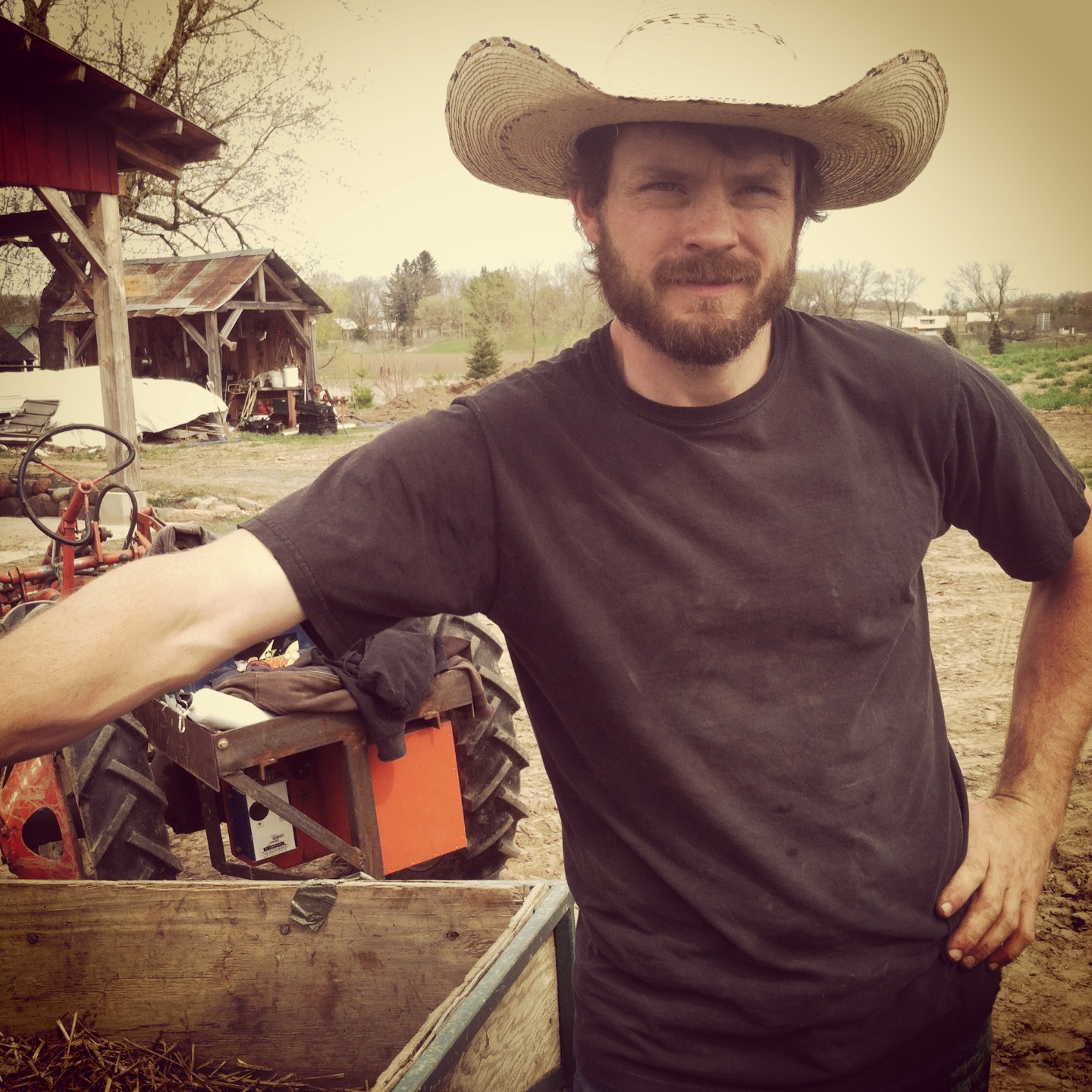
Ben's got the farmer look...
And so does Sarah.

Summer solstice was Friday, June 21. Here's to summer finally being here!


Saturday, June 1, 2013

Chemicals.

A few weeks back a single moment in the field hit me. I saw it with my own two eyes. It was not just an article I read or a scene I saw in a movie. It became real. I realized we have been so removed from how our food is grown and where it comes from. Even though Ben and I are continually trending in a direction toward sustainability and living naturally, in my mind, this moment thrust me forward ten steps.

At Common Harvest we put great attention and our whole energy into caring for the land we work, the food we grow, and the wildlife around us.

We were at work, finally in the field. Dan driving the tractor, Ben and I on the transplanter. We had just finished a row and were reloading some flats. We heard a rumble coming down the road. When you live out in the country, traffic is infrequent, it typically draws attention. We look up to see a semi truck hauling large tanks. The words out of Dan's mouth dropped like a ton of bricks on my ears, "there go the chemicals."

All of this went racing through my mind...

The seeds rest in my palm and one by one are placed into a fertile mix of potting soil and compost. The greenhouse is the perfect host for these seeds to germinate and flourish. We check the plants at least two times a day, water as needed. The sun produces a humid 80 degree climate. The ideal growing conditions.

But nature is not ideal. A winter that hangs on too long. Snow. The coldest April in over 100 years. More clouds than sun. A blizzard in May. Even though according to prior years many things should have been in the ground, we waited. And waited.

The snow melts. The temp rises. The soil slowly warms. But there has to be a transition. This is where the cold frame enters the picture. Plants are moved to 50 degrees and exposed to gentle breezes. The stems are able to strengthen and hold up the growing leaves. The plants have adjusted and are ready...

And at last so are some of the fields. Dan spent almost every day on the tractor for two weeks. It took about three hours per field spreading compost and poultry manure to enhance the nutrients for the forthcoming plants.

The tractor just fits into the tunnels and is used to prepare the center rows. But the most northern and the most southern has to be prepared by hand. With digging forks, we break the ground then wheelbarrow load by wheelbarrow load shovel compost down the whole row. Another go with the forks to turn in the compost. Five hours later one row is prepared for plants.

In the field we ride the transplanter to get the seedlings into the fertile soil. We have a flat with 98 plants on our lap, take one at a time, hold the soil block, place the stem and leaves into the spinning disks until they have a firm grip and grab the next plant. Do not be mistaken, this all happens very quickly. After a field is planted, we walk down every row to tuck in any plants that did not get covered by soil and to put a plant where we missed one.

The tunnels are a different process. We string a line to be sure we plant a straight row, get on our knees at the beginning, plant a seedling and measure the length to where the next one will go. A single row takes anywhere from 2-8 hours.

No matter where we plant, water is always needed. Hours upon hours are spent dragging layflat and hauling irrigation piping. A never ending job to be sure the plants are hydrated.

A late frost in the middle of May to a non farmer is just another day, maybe a crabby one, but not THAT big of a deal. But to a vegetable farmer, it is stress and time and money. Two days of unrolling row cover over the most delicate plants. All this put into saving a crop, knowing that the frost will actually only be a couple hour window over night - then it will be done and a new day of warmth will come.

With warmth come weeds. Pigweed. Purslane. Quack grass. Rye. Lamb's quarters. Some pretty, some edible, but when its not wanted, its a weed. We use wheel hoes and English style hoes and Diamond hoes. Row by row eliminate the weeds that are consuming nutrients from the soil. I used to be committed to doing P90X and Jillian Michael videos and going for 10 mile runs. Now, I wheel hoe. Seriously. a. workout.

With cold damp soils come pesty slugs and bugs. Cabbage maggots love...you guessed it, cabbage. We put row cover to prevent the attack. Every potato beetle we see, we smoosh between our fingers.

Our ten hour work days are spent nurturing and learning and planting and seeding and sweating and hoeing and walking and lifting and shoveling and managing. All because we are farmers. We want to produce good food.

Now, I am standing in this field, looking at this truck, and trying to comprehend how and why. Just down the road is the destination of these chemicals. An hour later, it comes back for a refill. We are surrounded by fields that are saturated in chemicals - apparently the answer to weeds and pests. The problem - these are synthetic, not natural. They are being sprayed onto the food we eat. They kill unwanted things. How can we be sure that these unnatural chemicals are not having a negative affect on our bodies? Chemicals are used in conventional farming because the amount of acreage covered by one farmer is too large to farm in great detail. Are these pesticides and herbicides sprayed onto these massive plots of land so smart that they only kill the unwanted? What about the monarch butterflies and the water we drink and the red belly snakes and the hummingbirds and the sunfish and the weeping willows?

These are thoughts I had before this moment. But like I said, it suddenly became very real. I saw the act happening.  The importance of our workdays just multiplied in my mind. There is a glaring need for small, sustainable, organic farmers. We as consumers need to be aware and connected to our food. We need to understand where it comes from and how it is grown and what is on it that should not be. We need to realize that we have power because of the food choices we make.

Saturday, May 18, 2013

This is layflat. The durable hose that is used to transfer water spewing at 30 gallons per minute. A secure connection is made at the water main and hundreds of feet run in different directions to the edge of the fields in need of water. 

Irrigation pipes are placed parallel in the center row. There should be fifty feet between each sprinkler. Make sure all connections are secure and do not forget the end cap. Turn the water on full force. Even at that speed, it takes a couple minutes before water is spraying out the sprinklers and hydrating the thirsty plants. 

Irrigation is never boring. There is always a leak, a spray, a puncture. Just when one is repaired, another appears. A field is watered over night to avoid evaporation and drying out from wind. This length of time on one field equals an inch of rain. Once plants are in the ground, irrigation has to constantly be on the mind of a farmer. It is a never-ending task. A constant battle of heavy hose and 30 foot pipes and ten trips to turn the water off then on and splicing and repairing and getting drenched from a sudden disconnection and hours upon hours of work. 

But its water. The main source of life. Its what blood is for humans. The vehicle that transports nutrients. Without it, life cannot go on. 

In my mind, rain has always been a good thing. But today, when we woke to the steady pitter patter of rain on the tin roof, I praised God for the life He was sending to every single plant we nestled into the soil these past two weeks. What one rainfall gave this morning was a weeks worth of irrigation. Another reminder of how big our God is and how small our efforts are in comparison. 


Sunday, May 12, 2013

Intense focus...get plants in the ground!

It was the week of planting. Emptying the Greenhouse. Getting things in the ground. One week ago, all the plants were in flats, protected from the wind, in a warm climate, becoming root bound.

Monday we kicked off the week by putting two rows of tomatoes and four rows of basil in the high tunnels. It was (at last!) a warm day. In the tunnels, 90 degrees, no breeze, and protection from the sun.


Tuesday we met Dan at the field north of the barn. Got the game plan. Loaded potatoes on the trailer, brought them to the field, pulled the quack grass, saturated the onions, loaded those on the trailer, brought them to a different field. Ready. Got introduced to the transplanter, the implement we will become quite familiar with. Planted one field of potatoes. 12 rows. Each row was 200 feet. 10 inch spacing. Thats nearly 3,000 potatoes we planted. Potential yield, 20,000 potatoes. Next up, bunching onions. 1,960 plants to be exact. For these, Margaret joined us on the 3 seater transplanter. As we are putting the plants in, we are so focused on not missing a beat that we are not able to look back on our row. When the pass is done, we look up and see a 200 foot row of little green onion tops poking up through the dark rich soil. To finish the day, we seeded peas and returned the empty flats to the greenhouse.

Introducing the transplanter
1 1/2 of these baskets will be used used for each row

If you look close you can see the little onion tops!

Seeding the peas

Wednesday. More potatoes. Total, one entire acre of spuds. More onions. Another 1,960 plants. Back to the tunnel. Two rows of eggplant. Two rows of cucumbers.

Thursday. It was cold and rainy. A great tunnel day. Beets. Four inches apart, two rows in one. So  really, four 200 foot rows. 2,000 beets.


To finish out the work week, Friday we put in 800 cabbage plants, 1,600 broccoli plants, and 800 lettuce plants. And to prepare for the upcoming cold weekend, we put row cover over the heat loving basil and cucumbers.


A satisfying week. Swinging between extremes. Monday, no plants in the ground. Friday, two tunnels and five fields full. Preparation for that first CSA box. Now, pray for steady temps and consistent moisture.


Saturday, May 4, 2013

Storytime

We have three stories for you.

#1
We walked to the middle field, just north of the barn. Our first day in the field, two weeks beyond our start date. Eight rows of kale stalks, dead; no longer full of rich, deep green leaves indicating life. Instead, three feet tall brown stalks, stripped of leaves, remnants of last season. Kale is a late season crop, able to be harvested even beyond the first frosts of winter, up til the ground freezes. For this reason the stalks are left in til spring, when hypothetically they are easier to pull. They need to be removed because they are so fibrous and if tilled into the soil, they get in the way during planting. It was time.

Dan demonstrated pulling a stalk, it did not give up without a fight. I attempted, my first stalk came right up, the second not so much. Dan grabbed his secret weapon, the branch cutter. The trick is to get as far down on the stalk as possible, a bit below the soil line. One hand on each handle, force them together until the stalk snaps. After ten stalks were laying on the ground, Dan left us to finish the whole field.

Ben and I switched between chopping stalks and throwing them into the trailer behind the G (the converted electric Allis-Chalmers cultivating tractor). Chopping involved squatting and bending and using biceps. Picking up involved bending and using forearm muscles and getting wet hands. Either way, we were working our bodies.

The air was crisp, with snow still on the ground, there was a slight chill rising. The sky was blue, the sun peering through the fairy tale like clouds. The birds singing and chirping in the trees at the edge of the field. A pair of sand hill cranes squall as they fly right above us. The distinct aroma of robust earthiness lingering from the kale. In the distance, a constant hum we assumed was a mega tractor in nearby field. We started discussing the joys of the work we were doing. Our bodies being used, our presence with the land, our experiences of nature, our lungs receiving fresh air, our ability to converse as we work together. In that moment, we did not envy those conventional farmers around us stuck inside large equipment, 12 feet above the ground, removed from all that creation has to offer.

After the field was free of stalks, we threw them over the fence to the draft horses (Molly, Jane, and Benedict). A special mid-afternoon treat. The field is ready to be tilled in preparation for new life to be planted.


#2
One of the three days above fifty in April was spent skinning (putting poly on) the high tunnels. These are those white crescent shaped structures you see on most vegetable farms, also known as hoop houses. The metal bows are left in the ground season after season, but the poly is removed in the fall and put back on in the spring. The purpose of a high tunnel is to create an ideal growing environment for plants. It extends the growing season by warming up the ground sooner than that exposed to all the elements of spring. Tomatoes and basil and eggplant and cucumbers are planted directly into the soil and fostered to grow to their greatest potential.

The wind was blowing at 5 mph, barely strong enough to move branches, practically considered a still day. Get a 26x200 foot tarp stretched out and it seems like a wind storm is erupting. It takes all five of us working together to keep it from blowing away. We begin with the north tunnel on the west side. The poly is wrapped around the end bows and clipped. With the plastic on the outside, we pull it up and assist it over the arch to the other side and continue 200 feet to the east end, fighting the wind the entire time. After the poly is in place, we begin at the west end, two people per side, throwing a rope over, wrapping it around hooks at the base of the poles, tightening, throwing it back, and repeating. When one rope is done, we begin another, crisscrossing it over the one we just finished.

Not just one tunnel, we skinned two before lunch. Ben and I continued the project in the afternoon by stretching and clipping the ends and hanging the doors. Typically this is a couple day project. This year, a single day.


#3
May 2. Two days prior was 65 degrees. That morning we woke to two inches of snow. It was chilly. We thought we were in the clear and could pack away our heavier winter clothing. Good thing we did not act on that thought. Layer upon layer, hats, insulated gloves, wool socks. 

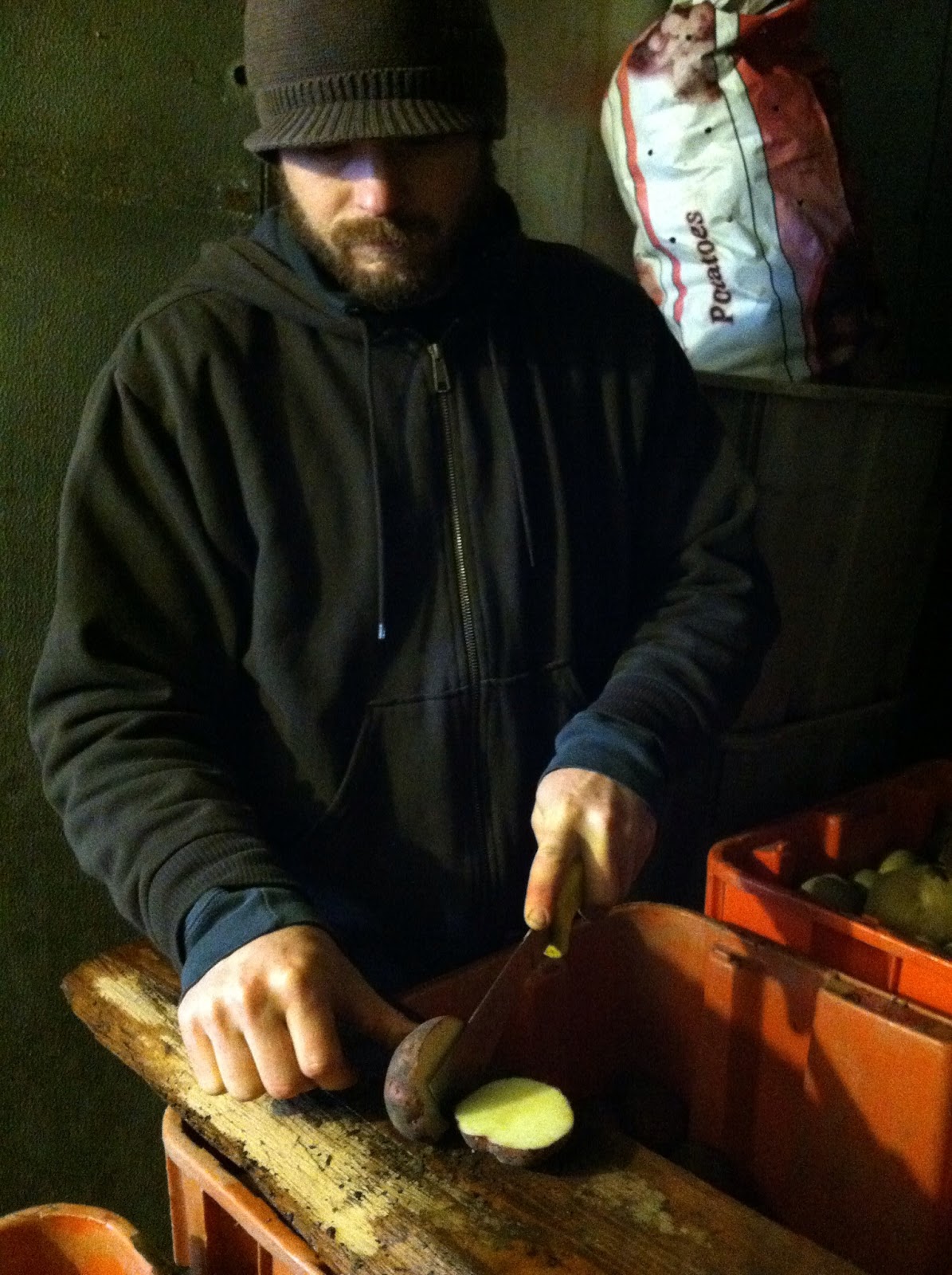
A week ago Dan picked up the seed potatoes. They were sorted into separate baskets based on variety and stacked in the pack shed breezeway. The day prior, Ben put them in the unplugged walk-in cooler to protect them from the extreme cold. Rather than pulling them out and working in the cutting wind, we set up in the cooler. It felt like a quasi-lit cave, a little damp and the all familiar dirt fragrance from potatoes.

There were 6 piles of baskets, stacked 4 high and many fifty pound sacks full of potatoes waiting to be sorted and cut. A seed potato has to be smaller than a racquetball in order to fit through the slit on the planter implement. Some were small enough, we threw those in one basket, others were too large, we cut those in half, thirds or even quarters. We will let them set, exposed to air for a week before we plant them, allowing the potato to cure. This is an attempt to avoid bacteria attacking the freshly cut potato flesh.

Approximately one thousand pounds of potatoes sorted and cut. We walked out into the brisk fresh air, the heavy snow clouds had lifted a bit. The day was starting to brighten just as it was coming to an end. The stark difference of weather in just twelve hours is astonishing, I guess we should not be so shocked, this is the Midwest.